
India’s Sin Goods Taxation Overhaul: Central Excise Amendment Bill 2025
Parliament Passes Comprehensive Reform Ahead of GST Compensation Cess Phaseout
On December 6, 2025, Parliament approved the Health Security and National Security Cess Bill, 2025, marking a pivotal moment in India’s fiscal policy evolution. The Rajya Sabha returned the bill to the Lok Sabha on Monday, following its passage by the Lower House on Friday. This legislative action, introduced by Finance Minister Nirmala Sitharaman, represents the government’s strategic response to augment expenditure on national security and public health. The cess, levied on the production capacity of machines in pan masala manufacturing units, will be over and above GST and has been positioned as a cornerstone to fund the costs of national and health security.
Unlike previous tobacco-focused legislation, this reform encompasses a broader category of products known as “sin goods” items deemed harmful to health or society. The bill arrives alongside the Health Security and National Security Cess Bill, 2025, which targets pan masala and other notified goods explicitly, creating a comprehensive framework to maintain high taxation on demerit products while navigating constitutional and GST framework constraints.
The Genesis: Understanding GST Compensation Cess
When India launched its landmark GST reform on July 1, 2017, it fundamentally restructured the country’s indirect tax landscape by subsuming multiple central and state levies into a unified system. To address concerns from manufacturing states that feared revenue losses, the central government introduced the GST compensation cess mechanism, designed to last five years until June 30, 2022. This cess was levied on luxury items and sin goods at rates significantly higher than standard GST, compensating states for any shortfall below a projected 14 percent annual revenue growth from the 2015-16 baseline.
The COVID-19 pandemic altered this timeline. As state revenues collapsed during 2020-21, the central government borrowed Rs 2.69 lakh crore to compensate states for their GST revenue losses. To repay these pandemic-era loans, the compensation cess was extended by four years until March 31, 2026, with collections redirected from direct state compensation to loan servicing. By late 2025, with loan repayment nearing completion Finance Minister Sitharaman indicated full repayment within weeks of the bill’s passage the legal and fiscal rationale for the compensation cess began to evaporate, creating an urgent policy challenge.
The GST Rate Rationalization Context
The tobacco taxation reform must be understood within the broader GST 2.0 restructuring that began in September 2025. The 56th GST Council meeting on September 3, 2025, approved a dramatic simplification of India’s GST structure, consolidating the previous four-slab system (5%, 12%, 18%, 28%) into primarily two slabs: a merit rate of 5 percent for essential items and a standard rate of 18 percent for most goods and services.
Crucially, the Council created a special demerit rate of 40 percent for sin goods and luxury items. This 40 percent slab became effective on September 22, 2025, for most products except tobacco and pan masala, which continued under the old cess regime until complete loan repayment.
For luxury vehicles, this change eliminated the compensation cess entirely while consolidating taxation into the 40 percent GST rate, resulting in net price reductions for high-end automobiles despite the apparent rate increase from 28 to 40 percent. Similar consolidations occurred for aerated beverages, coal, and other luxury goods.
The Tobacco Problem: Constitutional Constraints
While other sin goods transitioned smoothly to the 40 percent GST slab, tobacco presented a unique challenge. The GST law caps the maximum tax rate at 40 percent—a constitutional limitation designed to prevent excessive indirect taxation. However, tobacco products currently face effective tax rates well above this ceiling when combining GST, compensation cess, and existing central excise duties.
Without intervention, the expiry of compensation cess would automatically reduce the total tax burden on tobacco products from current levels exceeding 60-70 percent to just 40 percent. Finance Minister Sitharaman emphasized that this would make cigarettes and other tobacco products significantly more affordable, contradicting public health objectives and India’s international commitments to tobacco control.
The Central Excise (Amendment) Bill solves this constitutional puzzle by reintroducing substantial excise duties outside the GST framework, which can be levied without GST’s rate ceiling limitations.
Proposed Excise Duty Structure: A Detailed Breakdown
The bill introduces dramatically elevated excise duties across tobacco product categories:
Unmanufactured Tobacco: Excise duty increases from 64 percent to a range of 60-70 percent, ensuring that raw tobacco materials remain heavily taxed before processing.
Cigars and Cheroots: These premium products will face 25 percent excise duty or Rs 5,000 per 1,000 sticks, whichever is higher a dual-rate mechanism preventing tax avoidance.
Cigarettes (Non-Filter): Short cigarettes (65mm or less) will attract Rs 2,700 per 1,000 sticks, while medium-length cigarettes (over 65mm but not exceeding 70mm) face Rs 4,500 per 1,000 sticks. This represents increases from the previous range of Rs 200-735 per thousand sticks.
Filter Cigarettes: Duties will range from Rs 2,700 to Rs 11,000 per thousand sticks depending on length and specifications, representing the largest segment of India’s cigarette market.
Other Tobacco Products: Chewing tobacco, hookah tobacco, zarda, scented tobacco, and smoking mixtures all see substantial duty increases with product-specific rates.
This excise structure ensures that once the 28 percent GST plus compensation cess regime ends, the total tax incidence remains constant or increases, maintaining both fiscal revenues and public health deterrence.
The Pan Masala Solution: Capacity-Based Cess
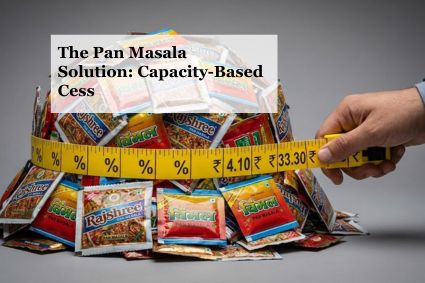
The companion Health Security and National Security Cess Bill, 2025, takes an innovative approach to pan masala and other notified goods. Rather than output-based taxation, this cess will be calculated on the declared production capacity of manufacturing equipment or processes.
This capacity-based system represents a significant departure from traditional tax administration. Both large manufacturers and small-scale producers, including handmade item creators, must register and pay a fixed monthly cess based on installed capacity rather than actual production. The government expects this mechanism to dramatically improve compliance and reduce under-reporting, which has historically plagued sectors like pan masala where cash transactions and informal production are common.
The bill’s dual naming Health Security and National Security Cess signals the government’s intention to dedicate revenues to both public health programs addressing tobacco-related diseases and national security expenditures, creating a direct link between harmful product revenues and protective government functions.
Policy Objectives and Broader Implications
Finance Minister Sitharaman articulated multiple objectives driving this legislative initiative:
Maintaining Tax Incidence: The primary goal is ensuring total tax burden on tobacco remains constant or increases, preventing any affordability gains that could boost consumption, particularly among price-sensitive youth.
Public Health Protection: Cigarette consumption alone is estimated to drain over one percent of India’s GDP through healthcare costs and productivity losses, making taxation a critical public health intervention alongside regulatory measures.
Revenue Protection: The new structure ensures neither central nor state governments experience revenue losses due to technical expiry of the compensation cess, with collections expected to continue at or above current levels.
Fiscal Flexibility: Reintroducing central excise duties gives the government the ability to adjust rates based on policy needs without GST Council consensus or constitutional rate ceilings.
International Alignment: Higher tobacco taxes align with World Health Organization recommendations and India’s commitments under the Framework Convention on Tobacco Control.
Export Competitiveness and Trade Balance: Understanding this reform requires context about India’s position in global tobacco markets. India ranks third worldwide in tobacco production with an estimated annual output of 300 million kilograms, and the country has emerged as a major exporter despite being a significant consumer. Between March 2023 and February 2024, India exported 19,691 tobacco shipments, representing a 27 percent increase over the previous year, with the United States, Nepal, and United Arab Emirates as primary destinations. The taxation reform aims to maintain this balance keeping India competitive in tobacco exports while ensuring that domestic consumption faces prohibitive pricing through heavy taxation. This preserves the competitiveness of India’s export-oriented tobacco agriculture sector while maintaining some of the world’s highest tobacco taxes for domestic consumption.
Impact for Businesses
The legislative changes will have far-reaching consequences across the tobacco and pan masala industries:
Immediate Cost Implications: Manufacturers will face substantially higher tax liabilities once the new excise duties replace the compensation cess structure. Companies will need to reassess their pricing strategies to maintain margins while managing potential volume declines from higher retail prices.
Supply Chain Adjustments: The capacity-based cess on pan masala will require manufacturers to register all production equipment and declare installed capacity, fundamentally changing how smaller players approach production planning and reporting.
Cash Flow Pressures: The transition from output-based taxation to capacity-based cess means manufacturers must pay fixed monthly amounts regardless of actual production or sales, creating potential liquidity challenges, particularly for seasonal or variable-output businesses.
Compliance Burden: Both large corporations and small-scale producers will need to invest in enhanced record-keeping, registration systems, and capacity declaration processes. Non-compliance penalties under the new framework are expected to be stringent.
Competitive Dynamics: Larger manufacturers with economies of scale may absorb tax increases more easily than smaller players, potentially accelerating industry consolidation. The capacity-based cess could particularly disadvantage smaller pan masala producers operating on thin margins.
Export Operations: While the reform maintains favorable treatment for tobacco exports to preserve India’s competitive position, exporters will need to navigate more complex documentation to ensure export consignments receive appropriate duty exemptions or refunds.
What Should Industry Do?
Businesses in affected sectors should take proactive steps to prepare for the transition:
Conduct Financial Impact Assessments: Companies should model the exact impact of new excise rates on their product portfolios, calculating changes in tax liability, required price adjustments, and potential volume effects. This analysis should inform strategic planning for 2026 and beyond.
Engage Tax and Legal Advisors: Given the complexity of transitioning from GST compensation cess to central excise duties, manufacturers should engage specialists to ensure proper classification, rate application, and compliance with both new and existing requirements.
Register Production Capacity Promptly: For pan masala and other goods subject to capacity-based cess, companies must complete registration processes as soon as implementation guidelines are released. Accurate capacity declarations will be critical to avoiding future disputes or penalties.
Optimize Production and Inventory: Businesses should evaluate whether to accelerate or delay production based on when different tax regimes take effect. Strategic inventory management could help smooth the financial transition.
Review Pricing Strategies: With significant tax increases ahead, companies need comprehensive pricing strategies that consider competitive positioning, volume elasticity, and margin requirements. Consumer research on price sensitivity will be valuable.
Strengthen Compliance Systems: Enhanced record-keeping, tracking systems, and internal controls will be essential, particularly for capacity-based cess compliance. Companies should invest in systems and training before deadlines arrive.
Monitor Implementation Details: The government will issue detailed rules, notifications, and clarifications in coming months. Active monitoring through industry associations and direct engagement with tax authorities will help companies stay ahead of requirements.
Consider Industry Advocacy: Trade associations should engage policymakers on implementation concerns, particularly around transition timelines, capacity measurement methodologies for pan masala, and provisions for small-scale producers.
Implementation Timeline and Next Steps
The legislation follows a carefully choreographed timeline:
- December 1, 2025: Both bills were introduced in the Lok Sabha
- December 3, 2025: Central Excise (Amendment) Bill passed by voice vote
- December 2025 (estimated): Complete repayment of COVID-related compensation loans
- March 31, 2026: Official expiry date of the GST compensation cess authority
- Post-March 2026: New excise duties and capacity-based cess become fully operational
The GST Council’s September 3, 2025, decision to continue compensation cess on tobacco and pan masala until loan repayment provided interim continuity, preventing any taxation gap during the transition.
Conclusion: A Sophisticated Fiscal Manoeuvre
The passage of the Central Excise (Amendment) Bill, 2025, and its companion Health Security and National Security Cess Bill represent sophisticated fiscal engineering that balances multiple competing imperatives. By replacing the temporary compensation cess with permanent excise duty and specialised cess mechanisms, the government has created a sustainable long-term solution that can adapt to changing fiscal and public health needs.
This reform demonstrates how tax policy simultaneously serves as a revenue tool, a public health intervention, and a mechanism to discourage the consumption of harmful products. The capacity-based cess on pan masala introduces administrative innovation that could serve as a model for other sectors facing compliance challenges.
As India continues to refine its tax system, nearly a decade after the GST revolution, this comprehensive sin goods taxation overhaul showcases the ongoing evolution of the country’s fiscal architecture and its commitment to using taxation as an instrument for both revenue generation and social policy. The reforms maintain India’s position as having some of the world’s highest tobacco taxes while preserving the competitiveness of its export-oriented tobacco agriculture sector. This delicate balance reflects the complexity of modern tax policy in a large, developing economy.
By entering the email address you agree to our Privacy Policy.